The plain-English version
Topical use is the main game: a 0.1 to 2 percent cream or serum, applied to clean skin morning and night, for at least 8 to 12 weeks. Injectable GHK-Cu is biohacker territory with no real research behind it. Always with a doctor or dermatologist if injectable.
Route: topical cream, topical serum, subcutaneous injection. Evidence tier for the dose: Strong clinical. Multiple human studies support the dosing protocol; not yet FDA-labeled for this exact indication but close.
The dose at a glance
| What's typical | What's the max in research |
|---|---|
| Starting dose: Topical 0.1 percent serum once daily for the first 2 weeks, scaling up to twice daily. Injectable: 1 mg subQ (under-the-skin shot) every other day if a clinician approves. | Max observed in research: Topical clinical trials capped at 2 percent concentration. No published max for injectable - biohacker community consensus, not clinical data, sets the ceiling around 2 mg every other day. |
| Maintenance dose: Topical 1 to 2 percent cream or serum, twice daily. Injectable users typically run 1-2 mg every other day for 4-6 weeks. | |
| Frequency: Topical: twice daily. Injectable (off-label): every other day or 3x weekly. | Half-life: Topical penetration window is hours, which is why twice-daily works. Injectable half-life in plasma is short (about 30 minutes) but copper-binding effects on tissue persist longer. |
Titration (how to ramp the dose)
Topical: start at 0.1 percent to test for skin reaction, then scale to 1-2 percent over 2-4 weeks. Injectable: most users skip formal titration (slow ramp-up); some start at 0.5 mg to test tolerance.
Cycle length and time off
On cycle: Topical: indefinite, like any skincare ingredient. Injectable: 4-6 weeks per cycle is standard.
Off cycle: Topical: no off cycle needed. Injectable: at least 4 weeks off after a 4-6 week cycle.
Timing notes: Topical: AM and PM on clean skin, before moisturizer. Injectable: time of day does not matter; rotate sites.
What's commonly prescribed (per published protocols and clinical write-ups)
Dermatologists do not typically prescribe GHK-Cu - it is sold as a cosmeceutical (cosmetic-pharmaceutical hybrid) by brands like NIOD, The Ordinary, and clinic-grade lines. Compounding pharmacies in the US can fill injectable GHK-Cu (lyophilized, freeze-dried and shelf-stable, vials at 50 mg) on a telehealth script, but most prescribers stick to topical.
Source: prescribing labels, published protocols, and clinical write-ups. We have not independently tested each prescriber pattern.
Reconstitution (mixing the vial)
Lyophilized 50 mg injectable vials reconstitute (mix back into liquid) with exactly 2 mL of bacteriostatic water (sterile water with preservative, the kind compounding pharmacies sell for reconstituting peptides). At 50 mg per 2 mL, every 0.04 mL on the syringe equals 1 mg. If your pharmacy filled the vial with a different volume, recalculate from the mg/mL printed on your vial label - not from this page. Store reconstituted vial in the fridge, use within 30 days. Topical creams and serums need no reconstitution.
Reconstitution = mixing freeze-dried (lyophilized) powder with bacteriostatic water (sterile water with preservative) so you can draw a dose into a syringe.
Where to get it
Honest take on where to source this peptide. Open the free account first; that's how we get credited even if you skip the code at checkout.
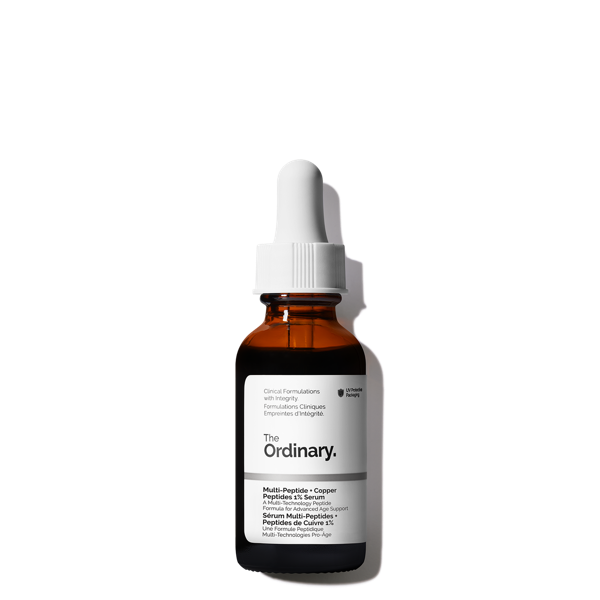
OTC topical - the easiest place to start
The Ordinary Multi-Peptide + Copper Peptides 1%
About $32 / 30 ml
Fits: You want the cheapest, lowest-risk way to try GHK-Cu - a cosmetic-strength copper-peptide serum you put on your skin today. For most people this is the right entry point, not the needle.
Watch: It's a 1% copper-peptide blend, not standalone GHK-Cu, at cosmetic strength - results show over months. A blend, ships with Prime.
Buy on AmazonAffiliate link. Full topical vs injectable comparison ->
Research-grade vial (injectable route)
Apollo Peptide Sciences
Fits: You have decided on the injectable route and want a research-grade GHK-Cu vial to reconstitute yourself. If you want a topical instead, see the buy comparison on the GHK-Cu directory page.
Watch: Labeled for research use only, not for human use, and not FDA approved. Apollo does not publish a purity percentage on the GHK-Cu listing. Apollo is not a 503A or 503B compounding pharmacy. If you want a prescribing doctor and a real pharmacy, this is not that route.
Step 1 Open a free account at Apollo Peptide Sciences ->Affiliate relationships are disclosed per FTC rules. Editorial take is independent of any commercial relationship; we only recommend what we'd actually use.
Drug interactions to watch
- No documented systemic interactions for topical use.
- Injectable use - copper interaction with zinc supplementation may matter at high doses.
- Avoid layering topical GHK-Cu with vitamin C in the same application (vitamin C can disrupt the copper-peptide bond).
Who should not take this (contraindications)
- Wilson's disease (a rare copper-metabolism disorder).
- Known copper allergy or sensitivity.
- Pregnancy and breastfeeding (no safety data for injectable; topical considered low-risk).
Common side effects
- Mild skin irritation in the first week of topical use (usually fades).
- Temporary skin tinting (slight blue-green from copper) right after application.
- Injection-site soreness or small bruising for injectable users.
Serious side effects (call a doctor)
- Allergic reaction (hives, swelling) - rare.
- No serious side effects have been documented in published topical research.
What to monitor while you're on it
- Topical: photo-document at baseline, 8 weeks, and 16 weeks.
- Injectable: copper and zinc levels at baseline and 6 months if cycling for more than 3 months.
- Watch for skin reactions in the first 2 weeks of either route.
How to stop
Just stop. Topical: skin reverts to baseline collagen turnover within months. Injectable: peptide clears in days.
Where this dosing comes from
- Pickart et al., GHK-Cu mechanism review (2015)
- Trueb et al., topical GHK-Cu hair clinical work (2018)
- Pickart, original wound-healing identification (1973)
- US compounding pharmacy formularies (Tailor Made, Empower) for injectable
- Cosmeceutical brand technical specifications (NIOD, The Ordinary, SkinMedica)
Where these doses come from
These doses come from human trials and prescribing protocols used by clinicians. Not FDA-approved at this exact dose, but well-supported by published data.
Always work with a real prescriber. Don't self-prescribe.
Safety reminder: None of this replaces a doctor. Peptides are gray-market in the US for most uses. Talk to a real prescriber before you change anything.
Where to go next
- Full GHK-Cu directory entry - status, sourcing, studies, what to skip
- Calculate your reconstitution math - exact units on your syringe, URL-shareable
- GHK-Cu for skin aging
- GHK-Cu for hair regrowth
- GHK-Cu for wound healing
- GHK-Cu for skin firmness
- What are peptides - if you skipped the foundation
- How peptides actually work - mechanism in plain English
- Subscribe to the dispatch
None of this replaces a doctor. Peptides are gray-market in the US for most uses. Talk to a real prescriber before you change anything.